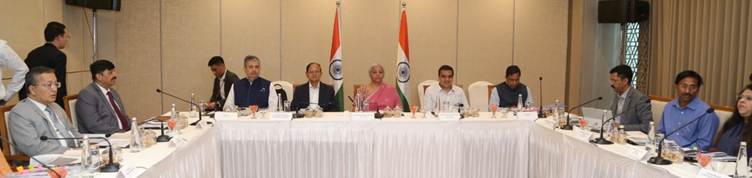
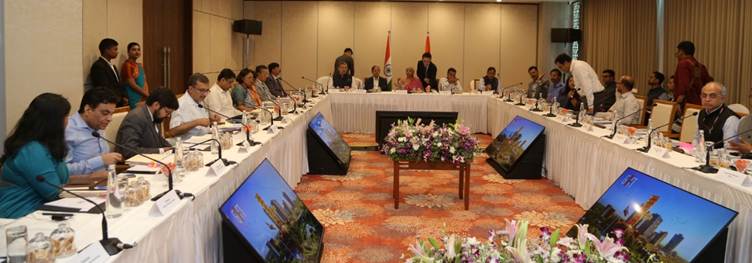
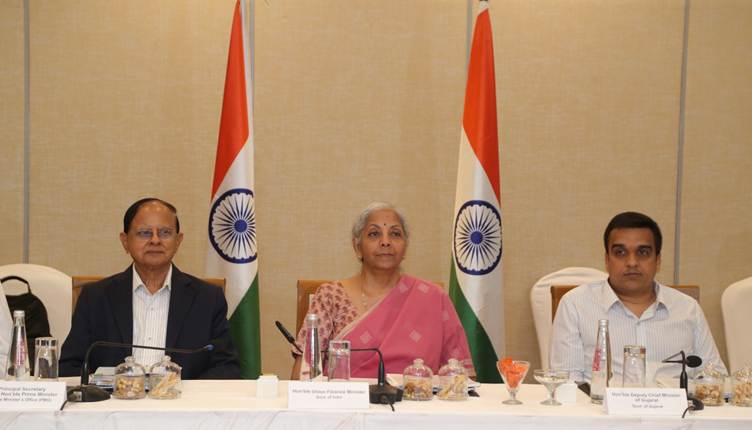
Union Minister for Finance & Corporate Affairs Smt. Nirmala Sitharaman chairs review meeting at GIFT City, Gandhinagar, in presence of Principal Secretary to the Prime Minister; and Deputy Chief Minister of Gujarat


Union Minister for Finance and Corporate Affairs Smt. Nirmala Sitharaman on Friday chaired a high-level review meeting on the progress of GIFT City and its evolving international financial services ecosystem, at GIFT City, Gandhinagar.

The review meeting was also attended by Shri P.K. Mishra, Principal Secretary to the Prime Minister; Shri Harsh Sanghavi, Deputy Chief Minister of Gujarat; senior officials from the Prime Minister’s Office, Ministry of Finance, Ministry of Corporate Affairs, Government of Gujarat, International Financial Services Centres Authority (IFSCA), and GIFT City officials.

Also present were Shri V. Vualnam, Secretary, D/o Expenditure; Smt. Anuradha Thakur, Secretary D/o Economic Affairs; Shri Arvind Shrivastava, Secretary, D/o Revenue; Shri Uday Kotak, Chairman of GIFT City; and Shri K. Rajaraman, Chairman, International Financial Services Centres Authority (IFSCA).

During the meeting, presentations were made on the progress achieved by GIFT City across sectors including banking, capital markets, fund management, insurance and reinsurance, aircraft and ship leasing, fintech, bullion exchange, international education and allied services.

Discussions were held on infrastructure development, talent ecosystem, ease of doing business, taxation framework, residential ecosystem and measures required for further strengthening GIFT City’s position as a globally competitive international financial and business hub.

GIFT City today hosts more than 1,150 entities operating across financial services, technology and allied sectors. Banking assets at GIFT City have crossed USD 110 billion, while capital commitments under fund management activities have exceeded USD 32 billion. The ecosystem includes 37 banking units, 217 fund management entities, 36 insurance companies, 35 aircraft lessors and 36 ship leasing entities, along with international exchanges, fintech firms and international universities.

In her address post review, the Union Finance Minister highlighted the strategic importance of GIFT City in deepening India’s integration with global financial markets and facilitating international capital flows into the country supported by globally benchmarked institutional frameworks, regulatory agility and supportive social ecosystem.

Noting that GIFT City has emerged as an important pillar of India’s international financial architecture and reflects the country’s growing economic confidence and global aspirations, Smt. Sitharaman stated that India today offers a unique combination of scale, technology, talent and growth opportunities.

The Union Finance Minister also highlighted the importance of futuristic discussions leading to immediate action driving ground level changes. The progress achieved so far is encouraging, and continued coordination among stakeholders will further strengthen GIFT City’s role in India’s growth journey towards Viksit Bharat @2047.

In his post review address, Principal Secretary to the PM underscored the importance of materialising the Prime Minister’s vision for GIFT IFSC by bringing in skilled professionals and creating world class infrastructure and lauded the efforts made so far in that direction.


WordEnglish MeaningHindi MeaningSynonymsAntonyms
WitnessesSees or observesगवाह बनना / देखनाObserves, NoticesIgnores
GloballyAround the worldवैश्विक रूप सेInternationally, WorldwideLocally
CompetitiveAble to compete successfullyप्रतिस्पर्धीStrong, CapableWeak
UnderscoresEmphasizesजोर देनाHighlights, StressesNeglects
MaterialisingMaking something realसाकार करनाRealizing, AchievingDestroying
EvolvingDeveloping graduallyविकसित होनाGrowing, ProgressingDeclining
EcosystemConnected system/environmentपारिस्थितिकी तंत्रNetwork, EnvironmentDisorder
AlliedConnected or relatedसंबद्धAssociated, RelatedUnrelated
InfrastructureBasic facilities and systemsआधारभूत संरचनाFramework, FacilitiesBreakdown
TaxationSystem of taxesकराधानLevy, DutyTax-free system
BenchmarkStandard for comparisonमानकStandard, CriterionInferiority
AgilityAbility to move or think quicklyफुर्ती / चपलताFlexibility, QuicknessSlowness
FacilitatingMaking easierसुगम बनानाHelping, AssistingHindering
CommitmentsPromises or obligationsप्रतिबद्धताएँDedication, PledgesNeglect
LeasingRenting property/equipmentपट्टे पर देनाRenting, HiringOwning
StrategicCarefully plannedरणनीतिकPlanned, TacticalRandom
ArchitectureStructure or designसंरचनाFramework, DesignChaos
AspirationsStrong hopes or ambitionsआकांक्षाएँDreams, GoalsHopelessness
FuturisticAdvanced and modernभविष्यवादीModern, AdvancedOld-fashioned
CoordinationWorking together properlyसमन्वयCooperation, CollaborationConflict
StakeholdersPeople involved/interestedहितधारकPartners, ParticipantsOpponents
LaudedPraised highlyप्रशंसा कीAppreciated, AdmiredCriticized

Comments

Popular posts from this blog

🇮🇳 Jurisdiction in India (भारतीय क्षेत्राधिकार)

🇮🇳  Jurisdiction in India (भारतीय क्षेत्राधिकार) 🔹  Meaning of Jurisdiction (अर्थ) Jurisdiction  means the  legal authority or power  given to a court to  hear and decide cases . Types of Jurisdiction in India Indian judiciary mainly has  three levels  of courts: Supreme Court (सर्वोच्च न्यायालय) High Courts (उच्च न्यायालय) Subordinate Courts (अधीनस्थ न्यायालय) Each has different  jurisdiction  as defined in the  Constitution of India . 🏛️ 1.  Supreme Court Jurisdiction (Article 124–147) (a)  Original Jurisdiction (मूल क्षेत्राधिकार) Supreme Court can directly hear disputes between: Government of India and one or more States Two or more States Example:  Dispute between Maharashtra and Karnataka over water sharing. Article 131  – gives this power. (b)  Appellate Jurisdiction (अपील क्षेत्राधिकार) Supreme Court hears appeals against judgments of High Courts in: Civil cases Criminal cases Constitutional case...

Foreign Trade Between India and the United States

    Foreign Trade Between India and the United States  Foreign trade between  India and the United States  is one of the most dynamic and expanding economic relationships in the modern global economy. The two nations have been major trading partners for several decades, with trade relations deepening further since the liberalization of the Indian economy in the 1990s. The relationship covers a broad spectrum of sectors, including goods, services, technology, defense, and energy. The United States is one of India’s  largest export destinations , receiving a wide range of products such as textiles, jewelry, pharmaceuticals, machinery, and information technology services. In return, India imports machinery, aircraft, electronic goods, and agricultural products from the United States. This exchange not only boosts bilateral trade but also strengthens economic cooperation and cultural understanding between the two countries. The  Information Technology (IT)...
Biography of Lal Bahadur Shastri

Biography of Lal Bahadur Shastri Introduction Lal Bahadur Shastri was the second Prime Minister of independent India . He is remembered as a man of simplicity, honesty, and strong willpower . His slogan “Jai Jawan, Jai Kisan” (Hail the Soldier, Hail the Farmer) became a source of inspiration for the entire nation. Early Life Lal Bahadur Shastri was born on 2 October 1904 in Mughalsarai, Uttar Pradesh . His father, Sharada Prasad Srivastava, was a school teacher, and his mother was Ramdulari Devi. He lost his father at a very young age, and the family faced hardships. Despite difficulties, Shastri completed his education with great determination. He studied at Kashi Vidyapeeth, Varanasi , where he was awarded the title “Shastri” (Scholar). Role in Freedom Struggle Shastri was deeply inspired by Mahatma Gandhi and joined the non-cooperation movement at a young age. He participated in various movements like Civil Disobedience and Quit India Movement . For his ac...